





Nikkei Business Publications, Inc. Bookmark
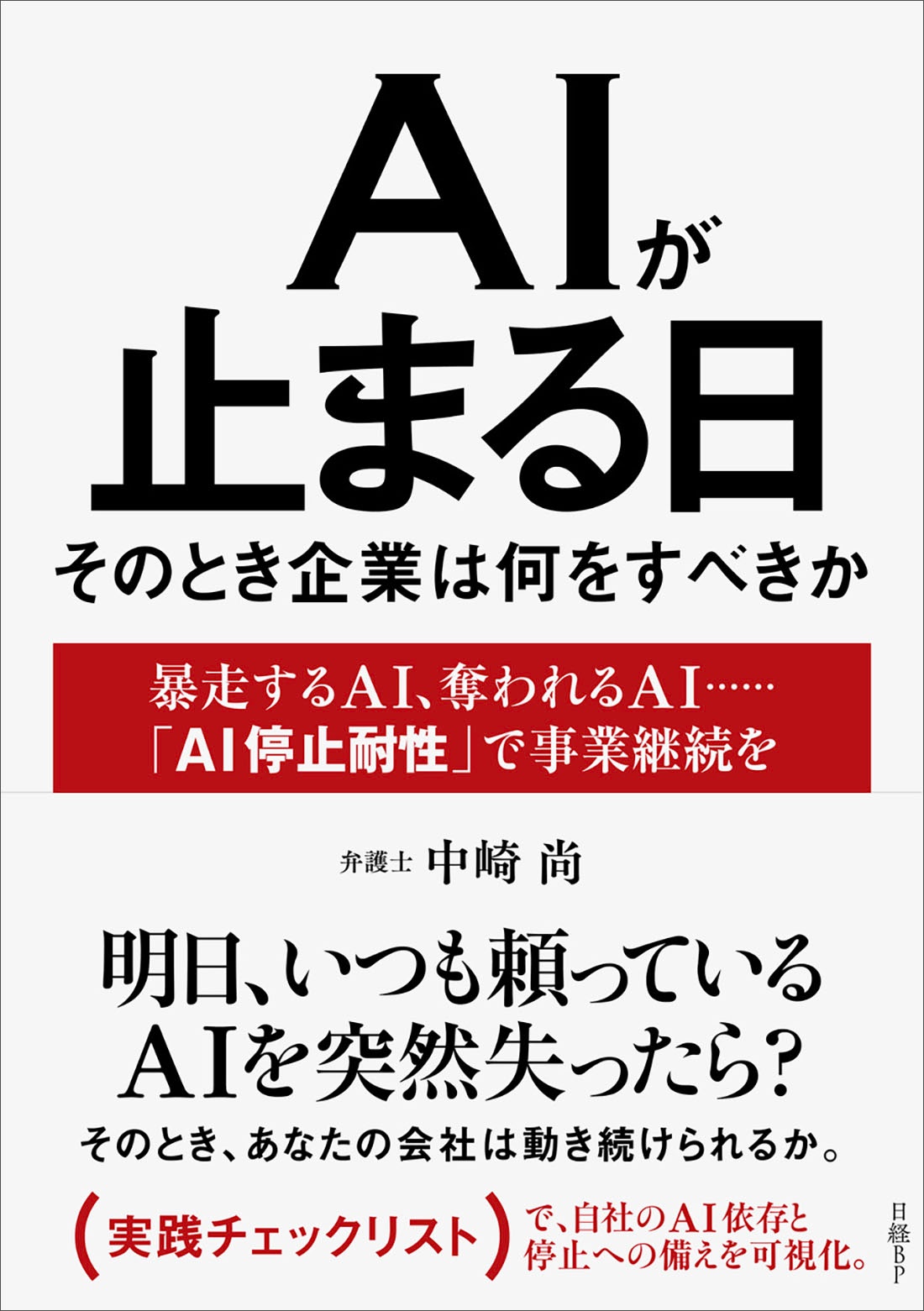
The Day AI Stops: What Should Companies Do Then?
Information will be available after you log in. Please create an account.
Rights Information
Other Special Conditions
Abstract
What if you suddenly lost the AI you rely on every day tomorrow? Would your company be able to continue operating then?
Generative AI is permeating daily operations, and AI agents that autonomously perform tasks are being introduced into the workplace. Physical AI, which supports robots and automated equipment, is also entering the practical application stage. AI is no longer merely a tool for improving operational efficiency. It is becoming a "business infrastructure" alongside power, communications, and cloud computing, and this is precisely why new management challenges are emerging for companies and organizations that tend to rely solely on AI.
If AI malfunctions and stops, its performance deteriorates, or it becomes unusable due to regulations, bans, or service termination, can companies and organizations continue their critical operations?
There are numerous factors that can cause AI to stop: widespread cloud outages, termination of infrastructure models, changes in terms of service, service termination orders from regulatory authorities, cyberattacks, AI agent malfunctions or failures, abnormal shutdowns of physical AI, and more. The risk of AI stopping, deteriorating, or becoming unusable, regardless of the company's own intentions, is now becoming a real management challenge.
In this book, we call the ability to prepare for AI failure "AI shutdown resilience." Now more than ever, companies and organizations need to enhance their "AI downtime resilience," concretely consider the impact of AI downtime and how to prepare for it, and implement "management based on the premise that AI will stop working."
This book categorizes AI downtime into six types: loss of trust, loss of control, adversarial intervention, external constraints, dependency breakdown, and safety-first type. It defines, evaluates, and strengthens the ability of "AI downtime resilience," and presents concrete ideas and practical methods from management, organizational, contractual, and technological perspectives. In addition, a "practical checklist" allows companies to visualize their degree of AI dependence and preparation for downtime.
Whether companies and organizations can evolve from "companies and organizations that use AI" to "companies and organizations that can continue to operate even if AI stops working" will determine their competitiveness in the future. This book is a useful resource for always keeping in mind and practicing "how managers should make decisions and how companies should prepare."
Author’s Information
Partner attorney at Anderson Mori & Tomotsune Law Offices. Auditor at the Japan Institute for Health Crisis Management (JIHS). Graduated from the University of Tokyo Faculty of Law and Columbia University Law School with an LL.M. in 2008. Involved in the draft of the "AI Business Operator Guidelines" as a member of the expert committee for the Ministry of Economy, Trade and Industry's "Survey, Research and Study Group Operation on Rules for AI Governance," and has served on numerous expert committees for the Ministry of Economy, Trade and Industry, the Ministry of Internal Affairs and Communications, and the Cabinet Office. Author of numerous papers and lectures, including "AI White Paper 2026" and "AI White Paper 2025" (both published by KADOKAWA), "Learn about the Use and Legal Aspects of Generative AI from Consultation Cases" (Yuhikaku), "Generative AI Law and Governance - Norms Shaping the Future," "Learn about the Risks and Countermeasures of Metaverse and XR Businesses through Q&A," and "Learn about the Risks and Countermeasures of GDPR through Q&A" (both published by Shoji Homu).
| Series/Label | --- |
|---|---|
| Released Date | Nov 2026 |
| Price | ¥2,400 |
| Size | 148mm×210mm |
| Total Page Number | 400 pages |
| Color Page Number | --- |
| ISBN | 9784296221318 |
| Genre | Business > Business/Management/Self-help |
| Visualization experience | NO |