





Nikkei Business Publications, Inc. Bookmark
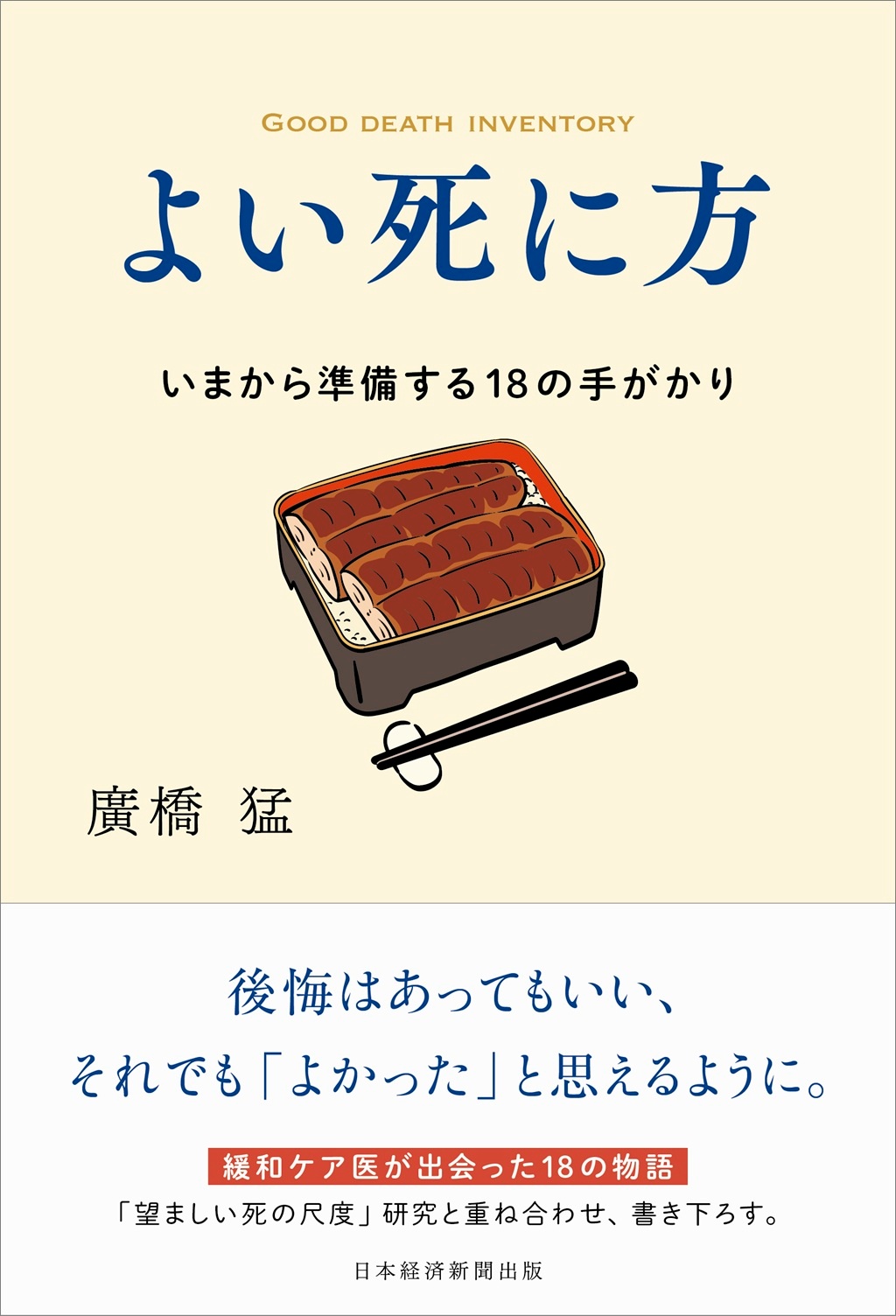
Good Death Inventory: 18 Tips for Preparing Now
Information will be available after you log in. Please create an account.
Rights Information
Other Special Conditions
Abstract
Everyone wishes for a "good death." But what can be done to make that happen?
The author, a palliative care physician who has witnessed the end of life for thousands of people, and who himself suffered from cancer, realized that there are "good deaths" and "unfortunate deaths." And whether or not you reach a "good death" is not just a matter of luck. You can choose a "good death" by taking action now.
- A 90-year-old woman who never let go of her monthly eel rice bowl until the very end.
- A hardware store owner who, for the first time in 60 years, said "thank you" to his wife.
- A former professor who left words for his son, whom he hadn't seen in 30 years, on his last night.
None of them were extraordinary people. But their end was a good one. Reading the 18 "true stories" in this book reveals what people who had a good end were doing at some point.
A "good death" is different for each person. But there are some guideposts.
A "good death" is one in which you can think "I'm glad I died in XX" when you die. What goes in the blank is something you decide for yourself. This book offers 18 guideposts to help you find that blank.
"The purpose of this book is not to be read and then forgotten. It is for you, the reader, to take action in some way. Have a hypothetical conversation with your family. Say the thank you you've been wanting to say. Make a promise to meet someone you've wanted to see... A good death is a good life." (From the book's "Afterword")
It's okay to have regrets, but still, be able to think, "It was all good."
Author’s Information
Palliative care physician and Director of the Cancer Care Support and Palliative Care Center at Eiju General Hospital. Adopting a “dual-track” approach—providing care simultaneously on the hospital’s palliative care ward and through home-based medical care at the Asakusa Nonaka Clinic—he is committed to supporting patients seamlessly from hospitalization through their return home. To date, he has accompanied thousands of patients and their families through the final chapter of their lives. Having personally undergone hospitalization and surgery for thyroid cancer, he considers his ability to discuss palliative care from both the physician’s and the patient’s perspectives to be a key strength. He graduated from Tokai University School of Medicine in 2005. He is a certified instructor and specialist with the Japanese Society for Palliative Medicine. His major publications include "A Beautiful Passing: How to Send Off a Loved One Without Regret" (PHP Institute) and "What a Palliative Care Physician Learned After Becoming a Cancer Patient: How to Live with Cancer" (Asa Publishing).
| Series/Label | --- |
|---|---|
| Released Date | Nov 2026 |
| Price | ¥2,000 |
| Size | 127mm×188mm |
| Total Page Number | 336 pages |
| Color Page Number | --- |
| ISBN | 9784296128297 |
| Genre | Business > Business/Management/Self-help |
| Visualization experience | NO |