





Nikkei Business Publications, Inc. Bookmark
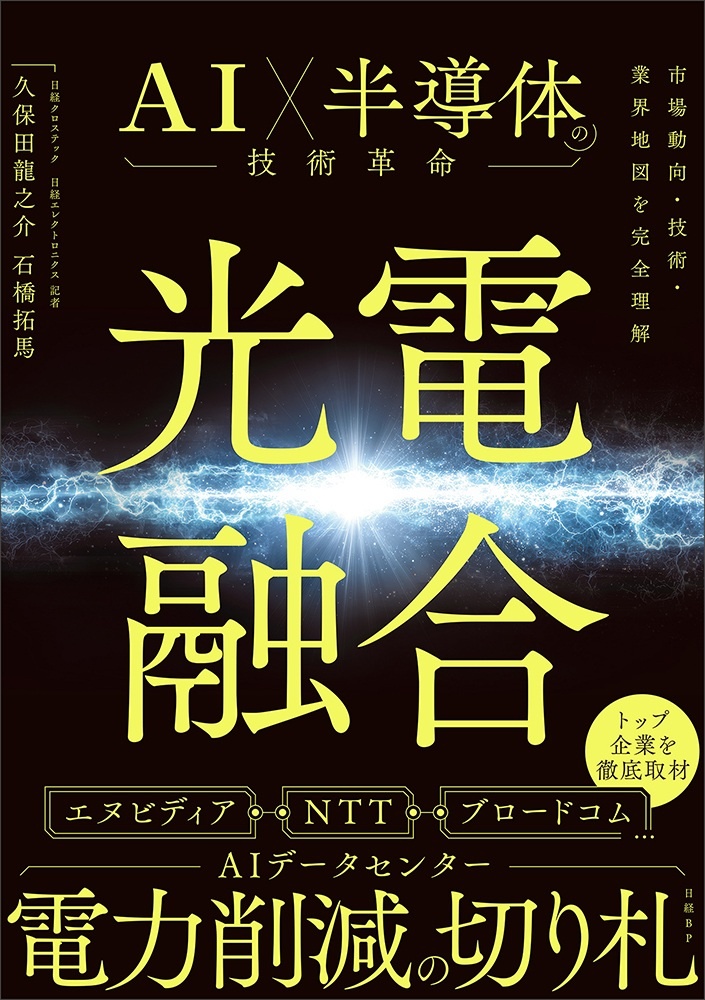
Optoelectronic Convergence: The Technological Revolution of AI and Semiconductors
Information will be available after you log in. Please create an account.
Rights Information
Other Special Conditions
Abstract
Computing technology is undergoing a major transformation with the advent of generative AI. A technology called "optoelectronic integration" has made its way right alongside semiconductor chips, the heart of computers. By replacing part of data transmission from electricity to light, it is seen as a potential solution to the power crisis of the AI era.
This book explains the present and future of optoelectronic integration through four themes. Two expert reporters from Nikkei BP's technology media outlets, "Nikkei xTECH" and "Nikkei Electronics," have compiled the results of in-depth interviews with leading domestic and international companies, researchers, and government officials in the field of optoelectronic integration. Chapter 1 explains market trends, Chapter 2 explains core technologies, Chapter 3 analyzes major players, and Chapter 4 explains components and materials.
Data centers that handle AI calculations now consume tens of megawatts of electricity in a single facility. This is equivalent to the electricity consumption of more than 10,000 ordinary households. In the United States, the enormous power requirements of AI data centers and cryptocurrency mining have led to increased electricity prices for ordinary households. The major US consulting firm ICF predicts that electricity prices in the United States will rise by up to 40% by 2030. Japan, with its booming data center construction, faces similar concerns.
Looking at the global development race, US semiconductor giants like Broadcom and Nvidia are leading the way. Japanese companies, including the NTT Group and component manufacturers, have a strong presence. They supply laser light sources, package substrates, and optical waveguides for optoelectronic integration to major manufacturers.
"It's so intense that we have to supply products even though the technology isn't fully mature," says an executive at a Japanese component manufacturer, describing the rapid rise of the optoelectronic integration market.
The boom in optoelectronic integration, which will support the AI society, shows no signs of slowing down anytime soon. Who will seize control of this market, and which technologies will become the de facto standard? Foreseeing these outcomes will provide important clues to understanding the future power dynamics in technology fields such as AI.
Author’s Information
Ryunosuke Kubota, Nikkei xTECH / Nikkei Electronics Reporter.
Born in Kawagoe City, Saitama Prefecture in 1994. Completed his master's degree at the Graduate School of Human Environment Studies, Kyushu University in 2020. Joined Nikkei BP in the same year and was assigned to Nikkei CrossTech. Covers the electronics industry, focusing on semiconductors and optoelectronic integration. Author of "The Counterattack of Semiconductor Nation Japan: A 2030 Revival Scenario" (Nikkei BP).
Takuma Ishibashi, Nikkei xTECH / Nikkei Electronics Reporter.
Born in Tamamura Town, Gunma Prefecture in 1992. Completed his graduate studies at the Graduate School of Engineering, Kyoto University. Specializes in chemistry and thermal engineering. Joined an automotive parts manufacturer in 2017 and spent his days researching in the R&D department. Joined Nikkei BP in 2022. After working as a Nikkei Manufacturing reporter, he has been in his current position since April 2024. Covers a wide range of topics including semiconductors, electronic components, batteries, and materials.
| Series/Label | --- |
|---|---|
| Released Date | Jun 2026 |
| Price | ¥3,000 |
| Size | 148mm×210mm |
| Total Page Number | 256 pages |
| Color Page Number | --- |
| ISBN | 9784296220045 |
| Genre | Technology / Engineering / Computers > Technology/Engineering/Computers |
| Visualization experience | NO |