





Nikkei Business Publications, Inc. Bookmark
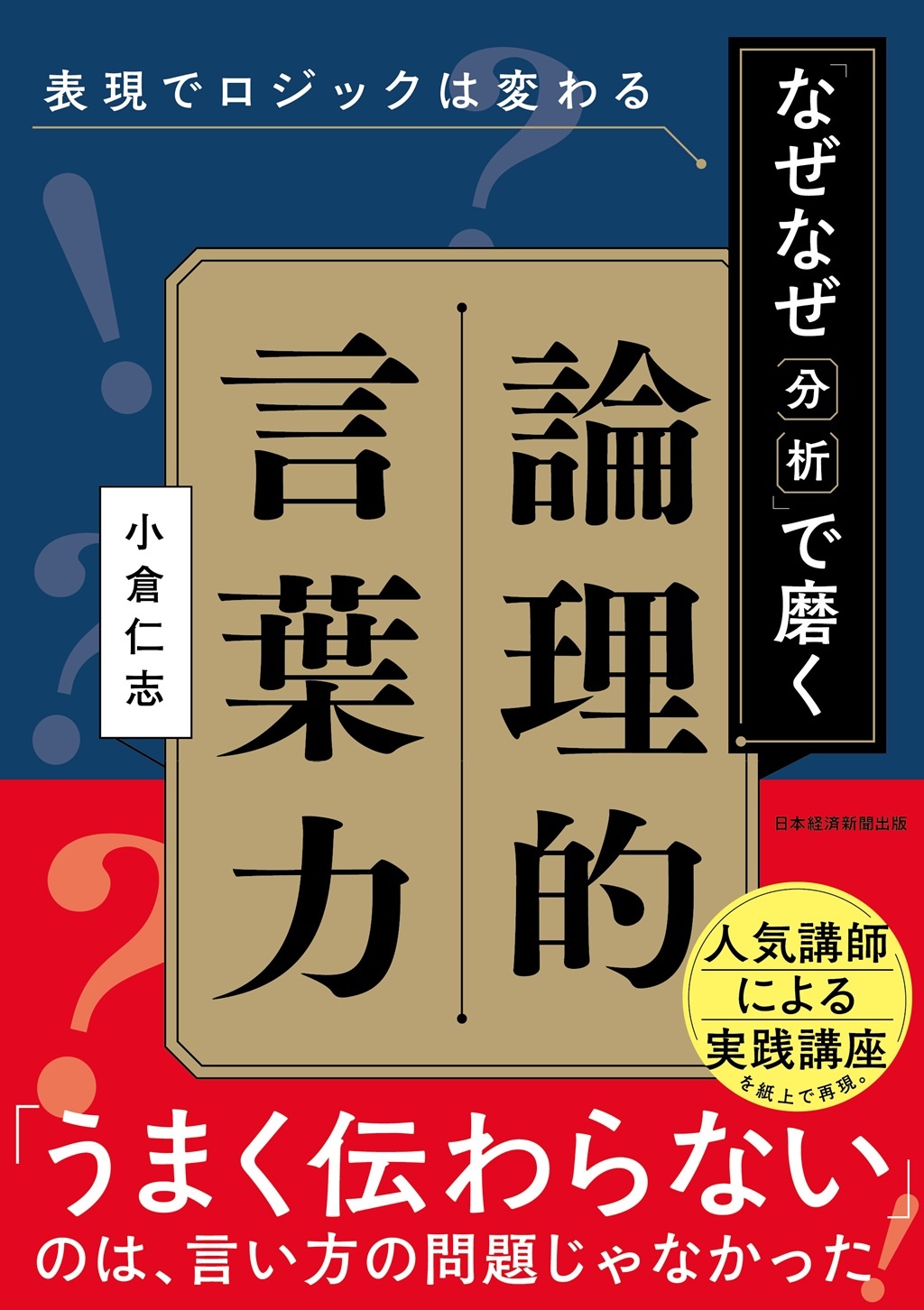
Honing Logical Writing Skills Through “Why-Why Analysis”: How Expression Shapes Logic
Information will be available after you log in. Please create an account.
Rights Information
Other Special Conditions
Abstract
"Not being able to communicate effectively" isn't just a matter of wording! How to hone your ability to convey the essence.
When you enter the workforce, you'll often face unexpected situations and be suddenly asked for logical answers by your boss, business partners, or customers. It's easy to answer based on knowledge you already possess, but it's not easy to logically explain what happened right in front of you.
In the first place, you probably weren't taught in school or at home what to pay attention to in order to think logically and answer "why?". How can you accurately answer "why?" and correctly convey your situation and thoughts?
To think and explain in a way that the line of your story is well connected, you need the right words (expressions). If we define thinking in a way that the line of your story is well connected as "logical thinking," then the ability to use the right words (expressions) to engage in that logical thinking is "logical language ability."
This book, written by an author with extensive experience in corporate training, compiles practical exercises to hone your logical language ability through the exchange of "questions," such as "why?", and their "answers." In today's world, where vast amounts of information are disseminated daily, it is crucial to avoid being misled by various sources, to think logically and thoroughly, to grasp the essence of a problem, and to develop the ability to articulate it. Furthermore, mastering ever-evolving AI hinges on being able to ask the right questions and to check the logic of the answers.
This article explains the key points for developing logical communication skills, using the "why-why analysis" method, which involves repeatedly asking "why?" and has become widely used in companies to investigate the causes of failures.
Author’s Information
President of Management Dynamics, Certified Management Consultant for Small and Medium-Sized Enterprises. Born in 1962. Graduated from the Faculty of Engineering, Tokyo Institute of Technology (now Tokyo University of Science). After working for foreign-affiliated chemical companies, he became independent in 2005 and established Management Dynamics Co., Ltd. Based on his independently devised "10 Rules of Why-Why Analysis," he conducts training and seminars both domestically and internationally. He also serves as a seminar lecturer for Nikkei BP. His numerous publications include "Practical Why-Why Analysis: Quickly Developing Problem-Solving Skills" (Nikkei Business Humanities Library, 2013), "Practical Why-Why Analysis: Quickly Improving On-Site Capabilities" (ibid., 2015), "100 Lessons to Hone 'Observational Skills x Expressive Skills' to Communicate in 'Seconds'" (Nikkei BP, 2023), and "Why-Why Analysis Application Techniques to Transform the Workplace, Organization, and Site: A Strengthening Guide to Root Cause Investigation for Everyone" (JUSE Publishing, 2025).
| Series/Label | --- |
|---|---|
| Released Date | Jun 2026 |
| Price | ¥2,000 |
| Size | 148mm×210mm |
| Total Page Number | 288 pages |
| Color Page Number | --- |
| ISBN | 9784296126842 |
| Genre | Business > Business/Management/Self-help |
| Visualization experience | NO |