





JIYUKOKUMINSHA CO.,LTD Bookmark
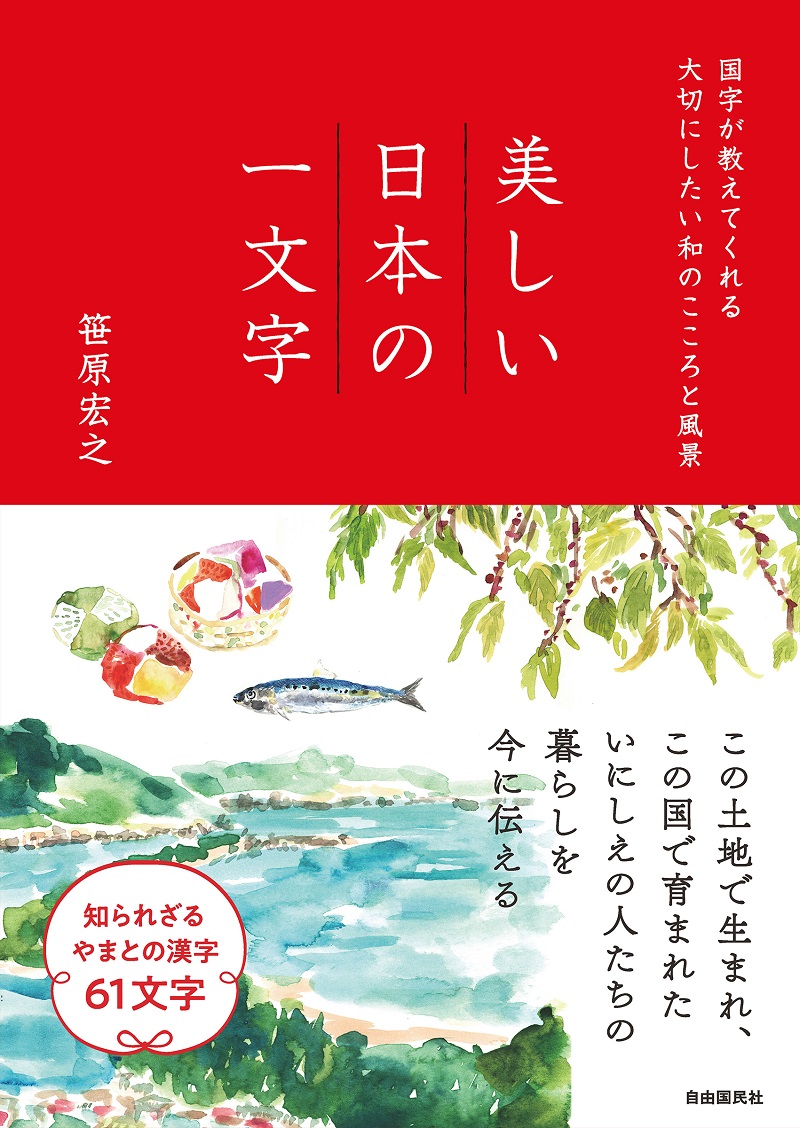
Beautiful Japanese Kanji, One Character at a Time
Information will be available after you log in. Please create an account.
Rights Information
Other Special Conditions
Abstract
Written characters survive across time and space, together with the paper and stone monuments on which they were inscribed.
Even if their readings have become archaic, if something about kokuji (kanji created in Japan) and kokkun (uniquely Japanese readings given to Chinese characters) still feels right to us, perhaps it is because they carry the sensibility, intuition, and intelligence that our Japanese-speaking ancestors cultivated while living in a land rich in nature.
In the way the components of kokuji were chosen and assembled, anyone willing to read them closely can discover surprising ideas and even delicate emotions.
Some kokuji have even traveled to China and Korea.
From among these characters, I have selected those that are especially rich in information, and I explain their history and characteristics in an accessible way.
Let us look at them together, one character at a time.
(From the author’s introduction)
Author’s Information
Hiroyuki Sasahara
Born in Tokyo in 1965. Professor at the Faculty of Social Sciences, Waseda University. Ph.D. in Literature.
Received the Kindaichi Kyosuke Memorial Award and the Ritsumeikan Shirakawa Shizuka Memorial Award for Oriental Character Culture for “Kokuji no Iso to Tenkai” (The Phases and Development of Kokuji; Sanseido).
Sasahara has also been involved in establishing and revising Japan’s official character standards, including the standard characters for administrative work (Digital Agency), JIS kanji (Ministry of Economy, Trade and Industry), jinmeiyo kanji, the kanji approved for personal names (Legislative Council of the Ministry of Justice), and joyo kanji, the kanji designated for general use (Council for Cultural Affairs of the Ministry of Education, Culture, Sports, Science and Technology), as well as NHK broadcasting terminology.
Author of many books, including “Nihon no Kanji” (Kanji of Japan; Iwanami Shoten), “Kanji no Rekishi” (The History of Kanji; Chikuma Shobo), “Nazo no Kanji” (Mysterious Kanji; Chuokoron-Shinsha), “Hogen Kanji” (Dialect Kanji; KADOKAWA), and “Hogen Kanji Jiten” (Dictionary of Dialect Kanji; Kenkyusha).
| Series/Label | --- |
|---|---|
| Released Date | Jan 2024 |
| Price | ¥1,545 |
| Size | 148mm×210mm |
| Total Page Number | 136 pages |
| Color Page Number | 136 pages |
| ISBN | 9784426129507 |
| Genre | Nonfiction / Humanities > Others |
| Visualization experience | NO |