





Nikkei Business Publications, Inc. Bookmark
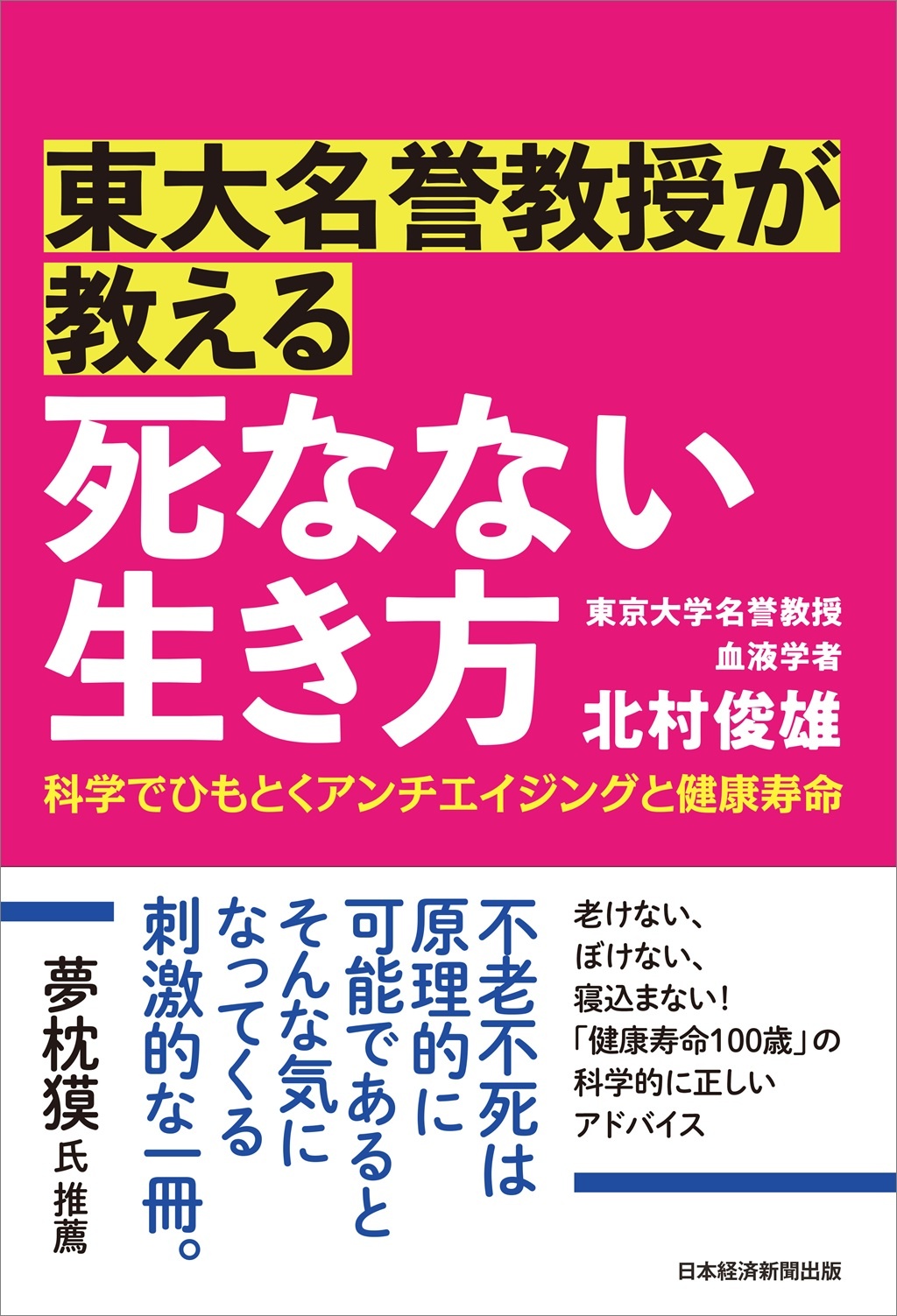
How to Live Without Dying
Information will be available after you log in. Please create an account.
Rights Information
Other Special Conditions
Abstract
Even after turning 100, you can live a vibrant, happy, and healthy life.
Near-future medical technology will enable us to slow the aging process, conquering various diseases, including cancer, leukemia, and stroke, and realizing an unprecedented society of longevity.
Professor Emeritus of the University of Tokyo, who has made achievements in a wide range of fields, including cell biology, immunology, and new leukemia treatments, and who contributed to the birth of iPS cells, will introduce the latest advances in life science and anti-aging research, while offering specific recommendations for exercise, sleep, food, medication, supplements, rest, and stress management to achieve a healthy lifespan of 100 years.
Key Topics:
- What diseases will be preventable in future medical technology?
- What are the genetic differences between centenarians?
- What is the longest-lived organism on Earth?
- Turtles and elephants are not immortal, but they do not age.
- Is it possible to rejuvenate yourself by replacing your blood?
- The relationship between weight, obesity level and life expectancy
- The surprising reason why the average life expectancy of Japanese people has increased
- How to prevent sarcopenia and frailty
- Exercises and gymnastics that are effective for knee, hip and shoulder pain
- The benefits of karaoke and dancing
[Table of Contents]
Chapter 1: Don't age, don't get senile, don't get bedridden -- the forefront of anti-aging
Chapter 2: Surprising facts about aging
Chapter 3: Where do aging and disease come from?
Chapter 4: Behavioral habits that lead to a "healthy lifespan of 100 years"
Chapter 5: The science of diet, supplements and medicines that lead to a "healthy lifespan of 100 years"
Chapter 6: Intelligence, memory and sleep
Author’s Information
Born in Osaka Prefecture in 1956, he grew up in Hyogo Prefecture. After graduating from the University of Tokyo Faculty of Medicine, he completed his residency in internal medicine before joining the Third Department of Internal Medicine at the Faculty of Medicine. He was seconded to the Virology Division of the National Cancer Center Research Institute, where he conducted experiments on leukemia viruses. He then returned to the Third Department of Internal Medicine, where he conducted clinical and research work in hematology. At the age of 32, he studied abroad as a postdoctoral researcher at the DNAX Molecular Biology Institute in California, USA. At the age of 37, he opened his own laboratory. At the age of 40, he returned to Japan and became Japan's first endowed chair at the Institute of Medical Science, the University of Tokyo. In 1991, he became a professor at the Institute's Center for Advanced Medical Research. After serving as its director, he became the director of the Center for Advanced Medical Research at the Kobe Biomedical Innovation Center in 2022. He is a professor emeritus at the University of Tokyo.
His newly developed research methods and highly efficient retroviral vectors are used in over 8,000 laboratories both in Japan and overseas, leading to numerous important research achievements. His hobbies are music, reading, cars, and golf.
| Series/Label | --- |
|---|---|
| Released Date | Feb 2026 |
| Price | ¥1,800 |
| Size | 127mm×188mm |
| Total Page Number | 240 pages |
| Color Page Number | --- |
| ISBN | 9784296125418 |
| Genre | Hobby > Health and Fitness/Fashion/Beauty |
| Visualization experience | NO |